


Cloudflare’s New AI Agent Controls: A Guide for Proxy Users
A price-monitoring job can reach a website without obtaining usable price data. Cloudflare’s announcement on November 4, 2026 offers a new way to understand that distinction: site operators can identify personal AI agent traffic more clearly and apply finer access rules to supported agents.
For FlyProxy users, the important question is how to distinguish connection, session, and website-policy issues. This announcement does not mean that access rules have changed for every residential proxy.
What does the update include?
According to the official Cloudflare announcement, the update covers three main areas.
- Traffic visibility. The Bot Analysis chart in Security Analytics adds a Personal Assistants category. A new widget shows individual agents and request counts, with linked views of request paths, response status codes, and originating networks.
- Account-level identification. For sites using Account Abuse Protection, account views can show which personal agents act on a user’s behalf. The product remains in early access. Agent labels on login and sign-up events help investigate specific accounts.
- Finer access rules. The setting, now called AI Crawler and Agent access policies, supports an overall agent policy and separate policies for supported personal agents: allow, block on pages with ads, or block.
Cloudflare says existing Search and Training policies remain unchanged. Passing fuller context, such as user authorization and subscription eligibility, through agents is described as a next goal, not a capability already delivered in full.
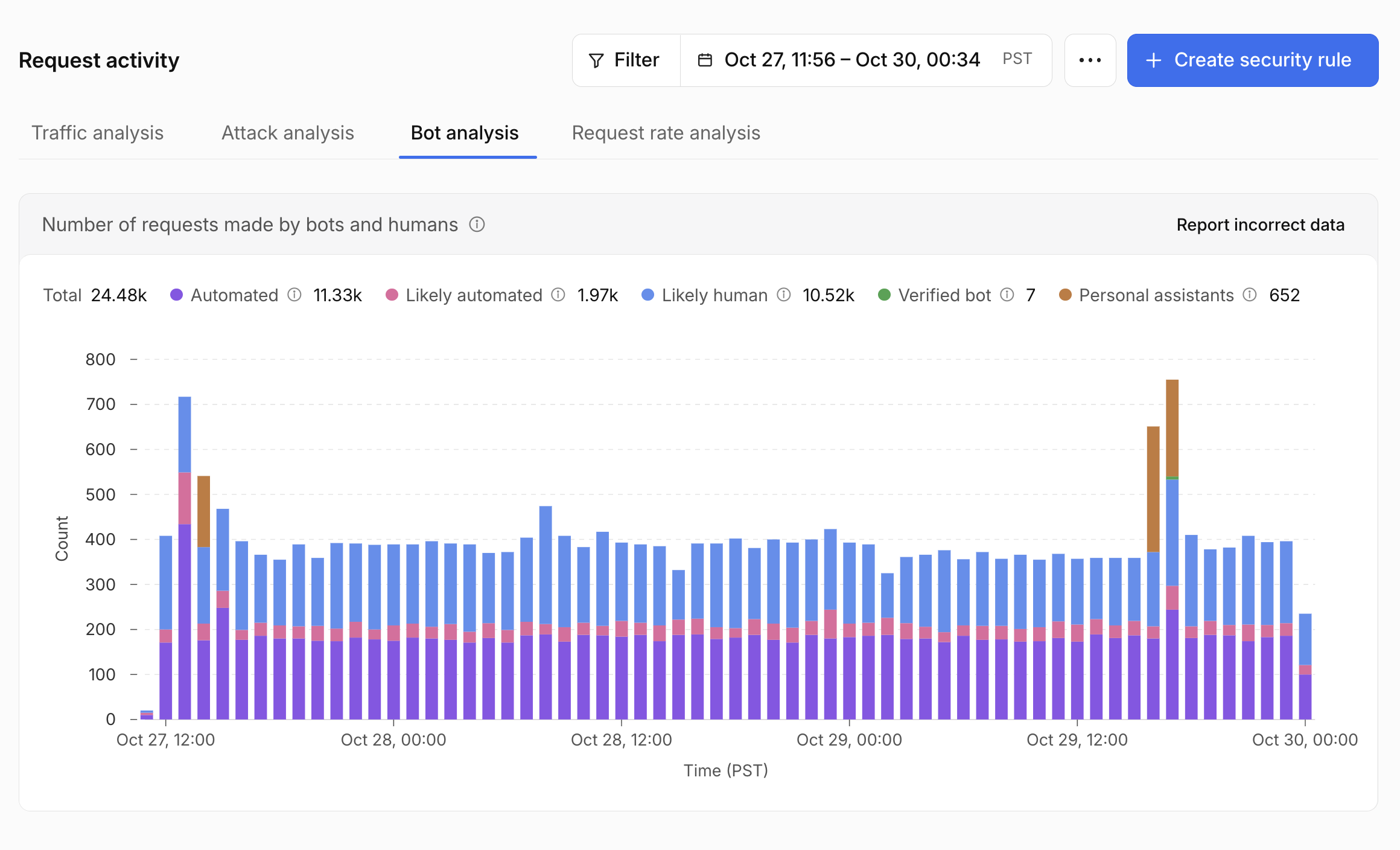
Cloudflare’s Bot analysis example includes the Personal assistants category. Request counts are example data from Cloudflare, not FlyProxy measurements. Source

Detail from the original legend: Personal assistants. The value 652 is example data in the source screenshot. Source
IP address, agent identity, and website rules are separate layers
A residential proxy affects the request’s network path and the source IP a destination usually sees. Personal AI agent identity describes the software performing an action. Website access rules determine how the destination handles that traffic.
A stable residential IP therefore does not, by itself, prove user authorization or subscription eligibility. An identifiable personal agent must still follow the site operator’s configured rules.
Two common terms also need separating: “static” describes whether an address persists, while “residential” describes its origin. A proxy labeled ISP should not automatically be equated with a connection on household broadband equipment.
For data teams, this change suggests a clearer diagnostic approach: separately check whether a network connection exists, which actor the website recognizes, and whether that actor may perform the requested action. The announcement does not say all proxy traffic will be classified as personal AI agents or that all websites have enabled these features.
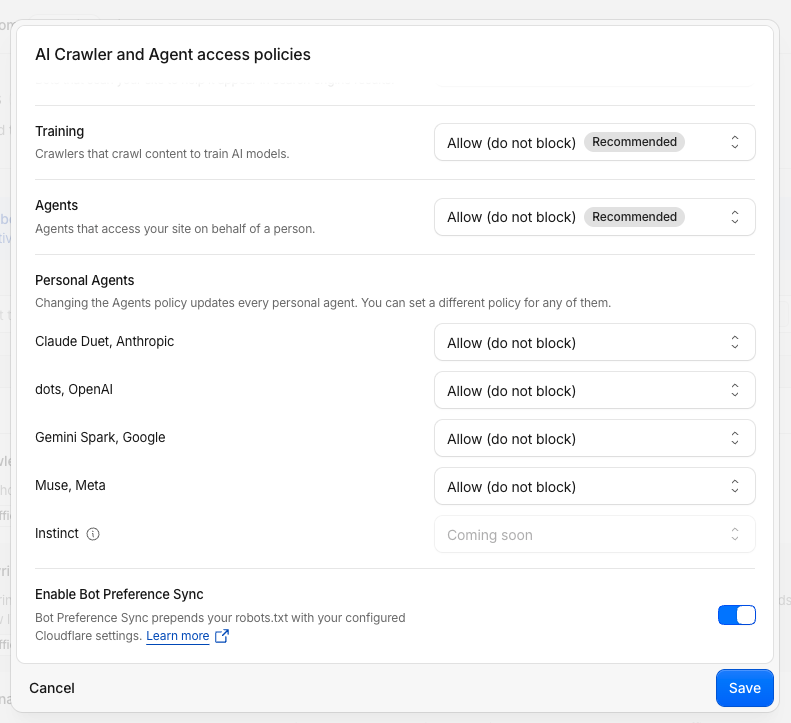
Cloudflare’s access-policy settings example. It shows policy controls, not feature availability for every account or a guarantee of access. Source
Inspect the response before changing proxy settings
First, do not count HTTP 200 alone. Verify that the response contains the expected product, price, currency, availability, and region. Login or consent pages may also return a success status. Mark missing prices as missing, not as zero.
Second, separate connection failures from website responses. DNS errors, connection timeouts, and TLS errors call for checking the client, proxy route, and destination connection. An HTTP response means an application-level answer arrived, but an intermediary may have generated it. Record the status code, relevant response headers, and a necessary content sample to help locate the cause.
Third, do not infer a specific policy from a status code alone. A 403 can have several causes; a 429 commonly concerns rate limiting. Consider the response explanation and the website’s published access requirements. When the website explicitly denies the activity, pause that workflow and confirm an available access method.
Fourth, record the scope of the problem. Do all pages fail, or only certain pages, accounts, or regions? Timing close to a product announcement is an investigative clue, not direct proof of causation.
Choose session stability or rotation for the task, then test small
When a task involves several related requests, a stable session can reduce unnecessary changes in network context. For regional comparisons, select locations according to the research design and keep currency, account state, and language conditions consistent. Rotation should serve the collection design.
FlyProxy’s rotating residential proxies page lists configurable rotation and sticky sessions. Its static residential proxies provide a static option and list HTTP(S) and SOCKS5 support. Choose according to location and continuity needs, then verify the configuration against actual target pages. These product features do not change a destination’s access rules.
Before scaling, test a small set of representative pages you are allowed to access: check whether data fields are correct, classify failures, and confirm that session and location behavior match expectations.
One improvement you can make today is to add a content-validity check to an existing price-monitoring job and count network errors separately from website responses before increasing collection volume.
Sources
Popular Blogs
1.Nstbrowser - A Free Anti-Detect Browser Simplifies Web Scraping and Automation
2.First Choice For Social Media Proxies: Unlimited Residential Proxy
3.Residential Proxies and Brand Protection
4.Five benefits that residential proxies can bring to e-commerce
5.Static Residential Proxies With Operating Multiple Facebook Accounts
6.Setting up FlyProxy Proxies on XLogin Tutorial